
Living DNA Review
Our genealogists’ take on Living DNA
Would you like to explore your ethnic origins and genetic profile? With Living DNA, a single DNA sample can trace your geographic origins to 21 subregions in the United Kingdom and Ireland and 72 subregions in Africa. The lab provides detailed ancestry reports, DNA matches, and genetic analyses related to nutrition, exercise, and vitamins. You can also order a book compiling your genealogical results, to keep for yourself or to give to your family for future generations.
Founded in 2016, Living DNA is a British laboratory specializing in DNA tests for ancestry and wellness. Its DNA kits analyze your genetic origins and certain characteristics related to metabolism and nutrition. We have reviewed its various DNA tests to provide you with our expert opinion as genealogists.
Key points about Living DNA
| Criteria |  |
|---|---|
| 🌐 Website | |
| 🏠Headquarters | Frome, Somerset, United Kingdom |
| 🧬 Types of DNA tests available | Ancestry Well-being Ancestry + Well-being Ancestry + Neanderthal |
| 🌏 Geographic regions covered | More than 150 regions around the world |
| 🧪 Sampling method | Buccal swab (cheek swab) |
| ⏳ Processing time | 6 to 8 weeks |
| 📜 Types of reports provided | Recent and subregional ancestry Paternal and maternal haplogroups DNA match Genetic wellness |
| 🔬 Reliability and Certification | ISO 27001 and ISO 9001 certified laboratory |
| 💵 Price | Ancestry DNA Kit: $119 Health DNA Kit: $149 Ancestry + Health DNA Kit: $199 Ancestry + Neanderthal DNA Kit: $145 |
| 📞 Customer Service | Contact Form Email: help@livingdna.com Phone: +44 203 823 6002 |
This page contains affiliate links, but this does not affect our independent opinion.
Living DNA: Strengths and Limitations
- Analysis of three types of DNA: autosomal, mitochondrial, and Y-chromosomal (for men)
- Analysis of genetic origins across more than 150 regions worldwide
- Detailed subregional breakdown for the British Isles and several regions of Africa
- Reconstruction of ancient ancestral migrations (up to 80,000 years ago) via haplogroups
- Family Networks tool to find DNA matches
- Option to order a personalized ancestry book
- Personalized reports on genetic health
- Regular updates on DNA results
- Option to import or export your raw DNA data
- Additional shipping fees apply outside the UK
- Longer processing time: 6 to 8 weeks
- Results are available only in English
- No family tree creation tool
- Customer service available exclusively in English
Our review of Living DNA on video
The different DNA kits
The ancestry DNA kit
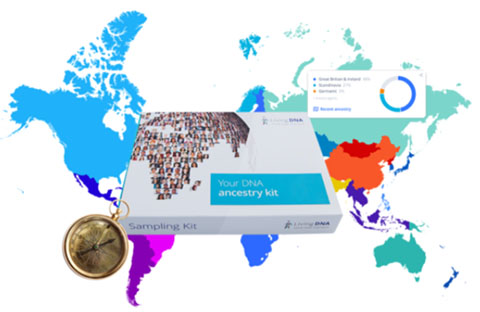
This test analyzes autosomal DNA, mitochondrial DNA, and Y-DNA (for men) using a single sample. One of Living DNA’s key strengths is the accuracy of its geographic analysis, covering more than 150 regions worldwide.
The test also analyzes the ancient migrations of your maternal and paternal lineages, dating back approximately 80,000 years.
The report includes:
- An estimate of recent origins
- A detailed subregional breakdown
- Identification of maternal and paternal haplogroups
The platform also offers a DNA matching tool that allows you to identify and connect with genetic relatives.
The Wellness DNA Kit
The wellness DNA test analyzes certain genetic variations related to metabolism, nutrition, and physical activity. The report details how your body metabolizes certain vitamins, as well as your sensitivity to gluten or lactose.
You’ll receive exercise recommendations and nutritional advice tailored to your genetic profile. You’ll also understand how your genetics influence how your body reacts to certain foods.
The Ancestry + Wellness DNA Kit
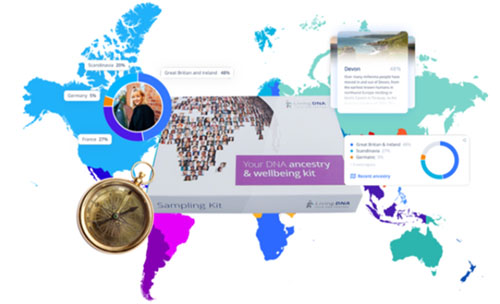
This kit combines the two previous options into a single, all-in-one package. You’ll receive access to all ancestry reports and wellness analyses based on a single sample. This package is more cost-effective than purchasing the two tests separately.
Ancestry + Neanderthal Kit
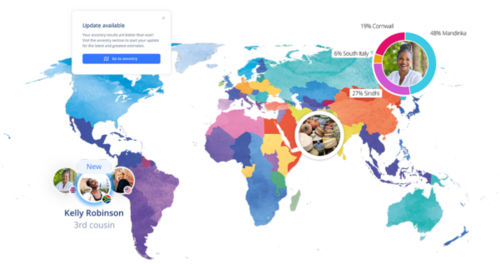
The Neanderthal kit includes all the features of the standard ancestry kit and adds a paleogenetic dimension: your Neanderthal DNA percentage. The laboratory calculates the proportion of Neanderthal and Denisovan DNA segments still present in your genome.
The report highlights certain traits inherited from archaic humans, such as sleep patterns, adaptation to altitude, skin pigmentation, or certain hair characteristics. The test also provides a detailed analysis of recent ancestry, using a chromosome painting method that allows you to explore approximately 500 years of family history.
You can also compare your proportion of Neanderthal DNA with that of other users in the lab’s database.
- High geographical accuracy for British, Irish, and African ancestry
- A detailed breakdown of your genetic origins by continent and region
- Trace the migrations of our ancestors from Africa
- Analyzes DNA segments inherited from Neanderthals and Denisovans
- Identification of DNA matches with an estimate of the degree of kinship
- More than 10 reports on well-being (endurance, recovery, lactose sensitivity, etc.)
- Analyzes the genetic response to certain vitamins and nutrients
The results we obtained
The percentage distribution of our genes
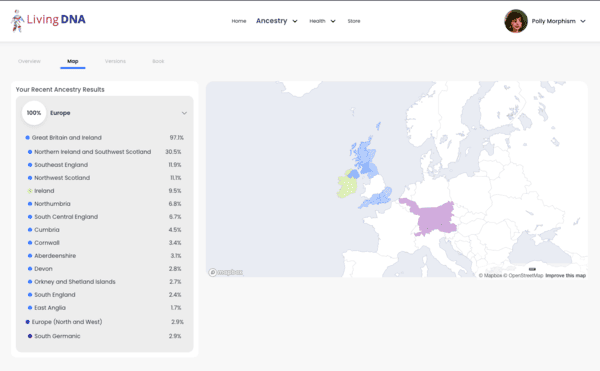
Living DNA organizes ancestry results into several levels of analysis. The first, called recent ancestry, covers the last 500 years and displays the geographic distribution of your DNA on an interactive map. In our case, for example, the analysis showed: 62% Western Europe, 28% Sub-Saharan Africa, and 10% the Indian subcontinent.
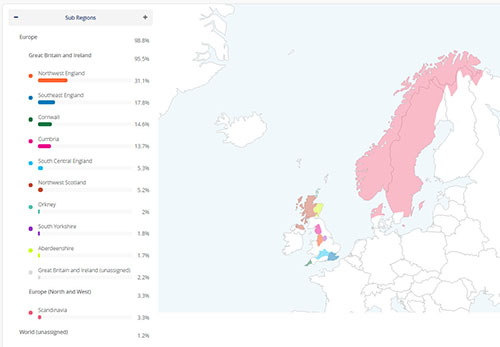
The second layer, subregional ancestry, refines these results within specific areas. For the British Isles, Living DNA identifies regions as specific as South Yorkshire, Aberdeenshire, South Wales, or the Scottish Highlands.
In Africa, Living DNA identifies populations such as the Mossi, Soninke, Wolof, and Yoruba. This provides a clear visualization of the different populations that make up one’s genetic ancestry.
Haplogroups and the migration routes of our ancestors
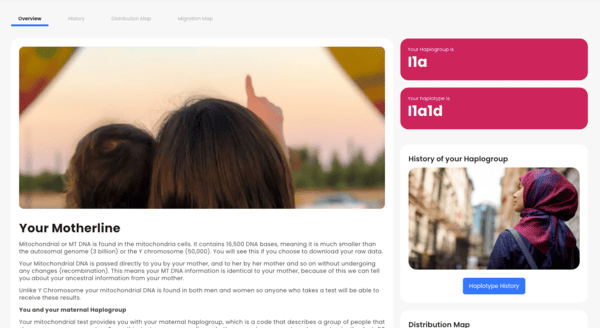
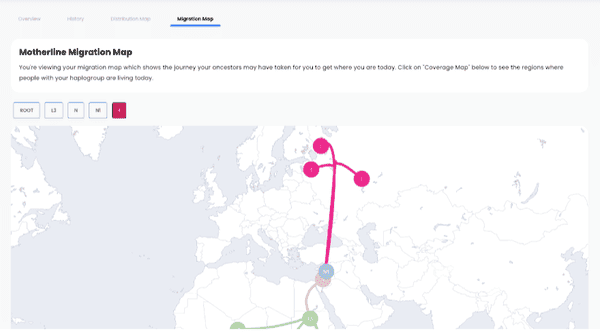
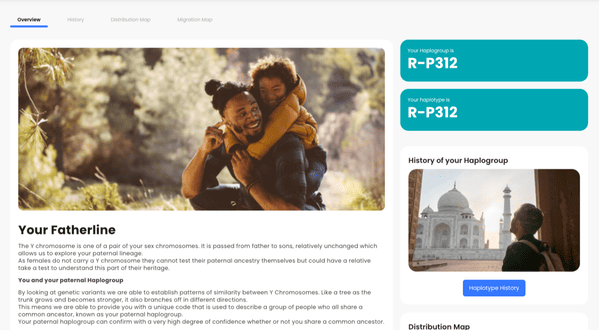
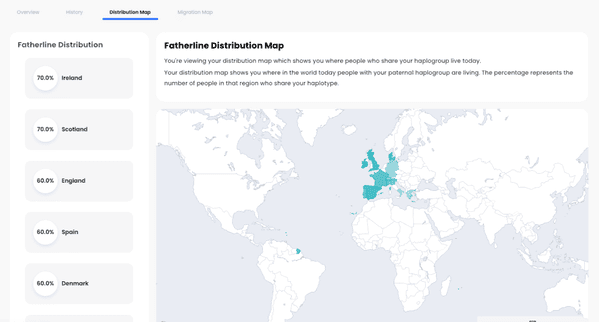
Living DNA analyzes Y-DNA and mitochondrial DNA to trace your direct ancestral lineage. It then matches your DNA to a haplogroup (a group of people who share a very distant common ancestor). An interactive map then allows you to visualize the migration routes taken by your ancestors from Africa, Europe, Asia, or Oceania.
The possibility of finding family members
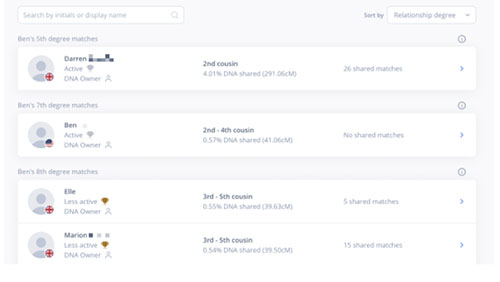
Living DNA helps identify DNA matches and locate close or distant family members. These matches may include cousins, half-siblings, or even genetic aunts and uncles, with an estimated degree of kinship of up to 8 degrees.
These DNA matches have, in particular, allowed us to reconstruct certain family branches. For adopted individuals, they can be useful in finding their biological family.
A detailed wellness report
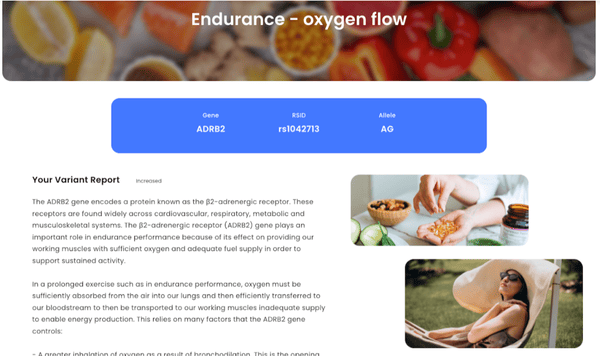
The Living DNA Wellness Report goes beyond a simple health checkup. It outlines genetic predispositions related to the absorption or metabolism of certain nutrients, such as vitamin D, iron, and omega-3s.
The report also explains how the body metabolizes certain nutrients such as carbohydrates, fats, lactose, and gluten. A section dedicated to recovery also analyzes muscle regeneration capacity after exercise, a factor often underestimated by athletes.
We received nutritional and athletic recommendations tailored to our genetic profile.
Focus on Ancestry Book by Living DNA
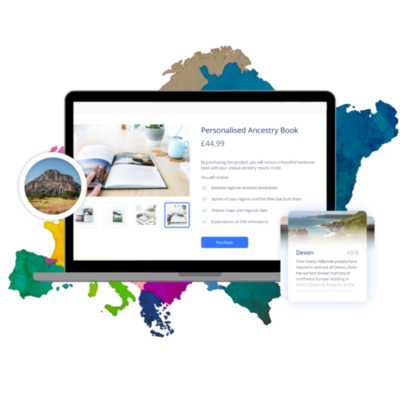
Living DNA offers to create and print a personalized ancestry book. This book compiles your ancestry data, haplogroups, migration routes, and regions of origin to help you better understand your family history.
Here are some of the features of Living DNA’s Ancestry Book:
- A detailed breakdown of recent ancestry, including maternal and paternal results
- A subregional breakdown of ancestry
- A chromosomal map allowing you to visualize ancestry over approximately 500 years
- A simplified representation of your family lineage
- Maps illustrating the geographic origins of your ancestors
- Historical explanations about ancestral populations
The Ancestry Book doesn’t simply replicate what you see online. It places each result within the history of human populations through maps and detailed explanations.
Just like the Living DNA test, you can give it to a loved one as a gift for a birth, holiday, or birthday.
How to take a living DNA test ?
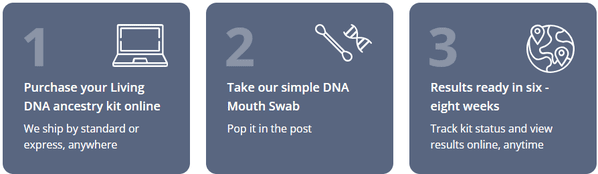
The process for taking a Living DNA test is simple and involves just a few steps:
- Choose your kit on the laboratory’s official website
- Create your account on the Living DNA website before or after receiving the kit.
- Activate your kit online by entering the barcode on the packaging
- Collect the sample by swabbing the inside of each cheek for about 30 seconds, then place the swab in the provided tube.
- Return your kit to the lab using the prepaid return envelope included in the package.
- Track the progress of your analysis directly from your Living DNA customer account
In our case, the results were available online after a 6-week wait.
Prices for Living DNA DNA tests
| Kit | Price in USD | Estimated price in euros |
| Ancestry Kit | 119 $ | ≈ 103 € |
| Wellness Kit | 149 $ | ≈ 130 € |
| Ancestry + Wellness Kit | 199 $ | ≈ 175 € |
| Ancestry + Neanderthal DNA Kit | 145 $ | ≈ 126 € |
| Ancestry Book (kit included) | 250 $ | ≈ 217 € |
Living DNA DNA tests are relatively expensive. However, we appreciate that the lab regularly offers promotions that make these kits more affordable. This means you can give one as a gift to a family member or loved one.
Living DNA’s Security and Reliability
Living DNA uses SNP chip genotyping, which examines hundreds of thousands of genetic markers in the genome. This method ensures both accuracy and fast processing. Analyses are performed by experienced scientists in ISO 27001 and ISO 9001 certified laboratories.
The laboratory guarantees the anonymity of samples. Only the unique barcode linked to your kit can identify your sample. Personal data is stored separately, and DNA is never shared without your consent.
Living DNA states that it does not sell your data to insurance companies or pharmaceutical partners. You can download your raw data at any time and request its permanent deletion from the database. The platform is secure (SSL encryption) and complies with the GDPR.
Living DNA Customer Service
There are several ways to contact Living DNA’s customer service:
- Online contact form
- Email: help@livingdna.com
- Phone: +44 0203 823 6002
A help center is available to provide you with numerous articles on activating DNA kits, interpreting results, privacy, and technical issues. However, customer support is available only in English, which can complicate communication for French-speaking customers. We hope the lab will make an effort to offer multilingual customer service.
Our Verdict on Living DNA
Living DNA is a reputable, reliable laboratory with trustworthy DNA analysis techniques. It is particularly useful for identifying your ethnic origins, finding family members, and tracing your ancestors’ migration.
The laboratory also provides information on metabolism and dietary advice tailored to your genetic profile. Additionally, other features of the laboratory have caught our attention and deserve to be highlighted.
The genealogy lab offering more details on British and African ancestry
Living DNA doesn’t cover thousands of geographic regions like EasyDNA or QuickDNA, but stands out for its greater geographic and regional precision. Honestly, few labs take ancestry analysis down to the level of administrative subregions (counties, provinces, islands, etc.).
We like the fact that the origin search covers specific areas in Oceania, the Americas, Asia, and Europe. But it is clearly in British and African origins that Living DNA is most precise.
For British ancestors, the lab identifies over 80 distinct areas, which is 8 times more detail than its main competitors. On the African continent, Living DNA uses an exclusive system of 72 subregions that offers five times more precision than the market average.
For someone who knows they have roots in the British Isles and/or Africa and wants to go beyond the simple statement “I am of Irish or Congolese origin”, Living DNA will allow you to discover your entire genealogical history.
Option to obtain a personalized genealogy book
We love Living DNA’s idea of transforming online genetic data into a physical, personalized, and heirloom-worthy item. This is a real asset that even its direct competitors have failed to develop. The Ancestry Book serves both as a research tool and a family keepsake to be passed down from generation to generation.
Living DNA or MyHeritage DNA
MyHeritage DNA outperforms Living DNA with its database (2,114 ethnic regions), effective DNA matches, and genealogy tools (family tree, research). Living DNA is more geographically precise, analyzes direct lineages (Y-DNA and mitochondrial DNA), and offers a family tree book as well as detailed analysis of British and African subregions.
Choose Living DNA for the family history book, health tests, and targeted research in Africa/the UK. Opt for MyHeritage for its included family tree software and in-depth DNA matches.
Living DNA vs Ancestry DNA
Ancestry DNA analyzes only autosomal DNA, but its database of over 27 million profiles allows for more advanced DNA matches. It also offers access to digital genealogy archives and a family tree builder.
Living DNA provides wellness analyses and details on subregions. Choose Living DNA for accuracy and wellness insights, Ancestry DNA for DNA matches and genealogical research.
FamilyTree DNA vs Living DNA
FamilyTree DNA excels at highly detailed Y-DNA and mtDNA testing to trace direct lineages back dozens of generations. The more affordable Living DNA offers a single kit combining all three types of tests. It outperforms FTDNA in autosomal analysis and regional accuracy, particularly for the British Isles and Africa.
FTDNA has a better DNA matching tool for finding relatives. Choose FTDNA if direct lineages/deep haplogroups are the priority, and Living DNA for a comprehensive, accurate, and affordable analysis.
Living DNA vs 23andMe
23andMe analyzes genetic predispositions to certain genetic diseases. Living DNA focuses on nutrition, exercise, and vitamins. For ancestry, Living DNA is more accurate for British and African regions, while 23andMe has a broader database for DNA matches. Choose Living DNA for the accuracy of its geographic origins and 23andMe to discover your predispositions to hereditary diseases.
In fact, you can import your 23andMe DNA data for additional analysis on Living DNA. colors, etc. However, Living DNA goes further with its wellness offerings and nutrition or sports advice, including personalized coaching.