Do you dream of tracing your family history? Do you want to know where your ancestors came from, understand their journeys, and discover their secrets? With online genealogy sites, millions of historical records are accessible directly from your computer. After using the various sites below to conduct our research and create a family tree, here is our analysis.
- MyHeritage : best free genealogy site to create a family tree and a large database
- Ancestry: best website for using a database developed to find one’s ancestors
- FindMyPast: the leading expert on British and Irish roots, offering access to the 1921 census and unique historical newspaper archives
- Heredis : best genealogy software offering free access to online archives
- Family Search: best genealogy platform equipped with a powerful search engine
- TheGenealogist : best specialized archive site for locating your ancestors’ homes and viewing exclusive British land records.
- Genes Reunited : best genealogy site for finding distant cousins and collaborating on shared family trees within a large community.
MyHeritage Family Tree Builder: the most popular genealogy website

With over 38.7 billion historical records, MyHeritage allows you to conduct genealogical research and create your family tree.
Thanks to Family Tree Builder, its family tree creation tool, you can:
- Add family members or import existing family trees in GEDCOM format
- Add photos, documents, and other multimedia files to enrich profiles
- Integrate maps
FamilyTree Builder checks data consistency, detects duplicates, and automatically searches for deceased individuals to keep your family tree up to date. You can sync your family tree to your MyHeritage account to receive alerts when new matches are found.
The free version allows you to add up to 250 individuals to your tree. Beyond that, the annual subscription costs between $84 and $269, depending on the plan you choose. To complete your tree data, you can take a DNA test to find out your ethnic origins. For more details on its genealogy tools, we invite you to read our full review of MyHeritage.
Ancestry: the go-to source for genealogy enthusiasts

Ancestry is a leading genealogy website that is very popular in the United States, but also widely used in Europe. It offers a collection of over 60 billion digitized documents from around 100 countries. This site is effective if your genealogical research focuses on Anglo-Saxon regions, North America, or Northern Europe.
Once you have created your family tree, Ancestry’s algorithm analyzes billions of records (censuses, passenger lists, military records, and directories) to suggest leads. Its user-friendly interface makes it easy to manage thousands of individuals. You can also take advantage of advice from experienced genealogists to help you with your research.
What’s more, by combining your results with an Ancestry DNA test, you can obtain accurate geographical information and details about your origins. Ancestry operates on a tiered subscription model, available on a monthly basis ($39,99) or for six months ($169). For more information, see our detailed review of Ancestry DNA.
FindMyPast: the platform for finding relatives of British origin
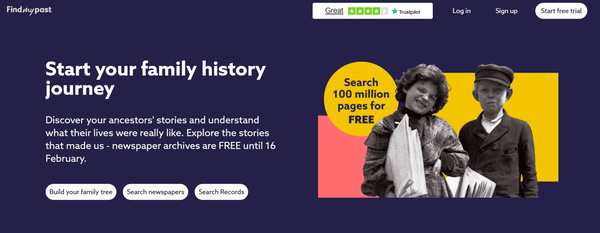
With over 8 billion records, Findmypast is the go-to site for tracing your roots in the UK, Ireland, or Australia. Its strategic partnership with the British Library and the UK National Archives provides access to major historical documents, some dating back to the 1500s:
- Parish records
- Marriage records
- Censuses
- Historical newspapers
- 1939 register
- 1921 census
- Handwritten letters
- Neighborhood maps
- Household member lists
To create your family tree, simply add family members you already know. The algorithm analyzes your data in real time to automatically suggest official records and ancestors to add to your branches. You can explore family trees shared by other community members to discover common ancestors and distant cousins.
A dedicated app allows you to manage your searches, add photos, and receive notifications. Findmypast allows you to import trees created on other platforms, making it easy to migrate if you change tools. Creating a family tree and consulting certain indexes is free. To access all documents and further your research, a monthly subscription is required, costing between $11.50 and $16.30.
Heredis: genealogy software

Heredis is different from traditional online genealogy sites because it is software that you download and install on your computer. Access is paid (starting at €16.99), but you can access certain features for free:
- Heredis Online: a search engine that allows you to search through 600 million historical and genealogical documents, with filtering tools (names, dates, places, etc.) to refine your results.
- Family tree creator: to create and view a family tree with up to 50 individuals
- Multimedia support: to integrate photos and documents into your family tree
- GEDCOM import and export: to facilitate data sharing and integration.
- Collaborative indexing: participate in the indexing of documents to enrich the collective database
- Tables and reports: consult genealogical statistics to refine your searches
- Data sharing: ability to share trees and information with other users.
The information provided by the Heredis search engine is available in several languages (French, English, Spanish, German, among others). It comes from reliable sources such as public archives, civil and parish records, as well as user contributions.
Heredis is ideal for advanced users who want to track their genealogy progress and benefit from an intuitive and customizable workspace to manage their data. Those who already use the desktop version will appreciate the synchronization with the online version. For more details on advanced features, you can check out our review of Heredis.
FamilySearch: a global treasure for genealogists

FamilySearch is a free genealogy research website run by The Church of Jesus Christ of Latter-day Saints. It has a vast database and powerful search tools that you can access for free to conduct your research.
Here’s what you can do on this completely free website:
- Discover your family history: search billions of ancestor profiles, photos, and archival documents
- Search for your ancestors in the shared family tree: view information that other people have provided about your ancestors in a family tree with over a billion profiles
- Create family trees: you can create your family tree online and add as many profiles as you want.
- View digitized documents: Free access to parish records, civil records, censuses, wills, and other digitized archives.
- Access collaborative indexing: Participate in indexing documents to enrich the collective database.
- Research guides: Access detailed articles and guides to help navigate archives and improve research techniques.
- Family history activities: learn more about yourself and your family by participating in various activities. You can compare your face to that of each of your ancestors to see who you look most like. Discover your family ties to famous people, share stories about yourself or your family members.
- Mobile apps: Download and use the FamilySearch mobile app to search and add information to your family tree on the go.
In addition, FamilySearch supports more than 20 languages to make access and searching easier. It is a valuable resource for genealogists of all levels.
The Genealogist : the platform for tracing your English roots
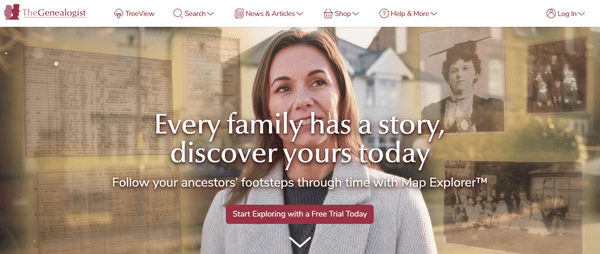
This genealogy website focuses its expertise on British archives. It offers access to millions of documents (English censuses, marriage certificates, wills, etc.). In addition to these archives, The Genealogist has specialized collections covering areas such as prisoners, sailors, and emigrants.
Its premium version, at $16.50/month (£14.16/month), unlocks access to Lloyd George’s exclusive surveys, British Air Force archives, and the national tithe collection. This historical data, which is regularly updated, is often difficult to access on more generalist platforms, making your targeted searches more effective.
The site includes MasterSearch, a search tool that makes your genealogical research easier. You can search for your ancestors by entering an exact address, keyword, surname, or using georeferenced historical maps.
With The Genealogist, you can also start building your family tree from your own information. The algorithm then suggests matches to help you complete it.
You can read our full review of The Genealogist to discover all its features.
Genes Reunited: the community website for finding your British ancestors
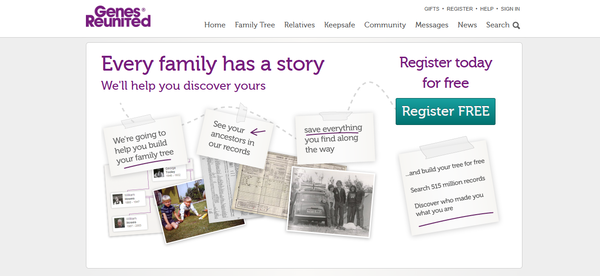
Genes Reunited emphasizes the human and collaborative aspects of genealogical research. You have access to historical British records (birth certificates, death certificates, military records, etc.) as well as millions of family trees created by its members. You can view these trees, send messages to their owners, and exchange information to complete your own family tree.
The system automatically compares your tree with those of other users and alerts you to potential matches. In addition, a close-knit community of researchers exchanges tips and leads on a daily basis to help overcome genealogical “walls.”
Feel free to read our review of Genes Reunited for more information.
Summary of the 7 best genealogy websites
| Site | Specialty | Strengths | Free/Paid |
|---|---|---|---|
| MyHeritage | International | 38.7 billion historical records Advanced family tree builder Automatic matches between trees or record collections Advanced DNA tools (genetic matches, ethnic ancestry estimates, shared segments) Old photo restoration tools | Freemium subscription and paid option starting at $84/year |
| Ancestry | International | Largest DNA database in the world Accurate family matching Public member trees Large media library | 14-day trial + subscription for $39.99/month |
| FindMyPast | UK/Ireland | British Archives Newspaper Archives Exploring Other Family Trees | 14-day trial + subscription for $16.30/month |
| Heredis | International | Software compatible with Windows, macOS, iOS/Android Visual and statistical tools (ancestry/descendants, graphs, diagrams, cross-tabulation tables Compatible with GEDCOM files | Starting at $16.99/month |
| FamilySearch | International | Millions of shared trees and historical records Access to digitized original documents Practical tools and resources | 100% free |
| The Genealogist | UK | Rich and exclusive collections of British historical archives SmartSearch search tool Contextual exploration via MapExplorer High-resolution census images and clean transcripts | Free trial, then subscription starting at $16.50/month |
| Genes Reunited | UK | Direct connection between multiple users Multi-criteria search tools Active community and shared resources | Free trial, then subscription starting at $5.68/month |
Other resources to consult for your genealogical research

In addition to these free genealogy websites, there are other resources you can consult to build your family tree and obtain accurate information.
- RootsWeb: a free genealogy community that uses online forums, mailing lists, and other resources to help people research their families.
- Gramps: free, open-source software available on Windows, Mac, and Linux. It offers many features for genealogy, such as creating family trees and managing events.
- Legacy Family Tree: is a comprehensive genealogy software program available for Windows. It offers a multitude of features, such as creating family trees and managing media. It makes it easy to document and organize your genealogical research.
- Ancestris: is free, open-source software compatible with Windows, Mac, and Linux. It offers many features for genealogy, including creating family trees and managing sources.
Who should do research and create a family tree?
Undertaking genealogical research and creating a family tree is something that anyone who wants to learn more about their family origins can do. However, this activity is more relevant for certain profiles:
- The diaspora and expatriates: to preserve the link with their roots and pass on family history to generations born outside their country of origin
- Dispersed families: to identify distant heirs, particularly in the context of complex inheritance settlements
- Future parents: to compile a complete family history to pass on to their children
- Retired seniors: to invest their free time in an intellectual project that stimulates curiosity and memory
How to start your family tree ?
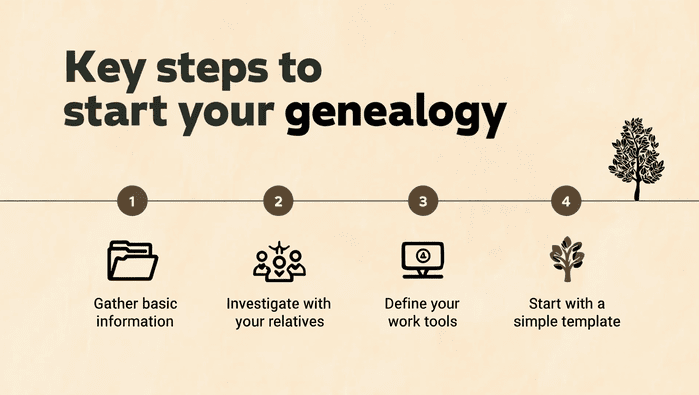
Here are the key steps to get started with your genealogy:
- Gather basic information: start by writing down your name, date, and place of birth. Then extend this to your parents and grandparents, going as far back as you can remember. Use a blank sheet of paper or a digital document for this.
- Ask your relatives: your ancestors (parents, uncles, aunts) often have crucial information. Take advantage of family gatherings (lunches, visits) to ask them about ancestors you don’t know yet.
- Define your working medium: before you start, try out different methods (paper, online tools, mind mapping applications) to find the format that best suits your style for creating your family tree.
- Start with a simple template: to help you get started, many websites offer blank family trees that you can print for free. Download one to record your initial data, before potentially transferring it to a more sophisticated tool later
How can you stay organized as your family tree grows?
Create a consistent filing system from the outset by naming your files using a clear logic: “LAST_NAME_First_Name_Document_Type_Date.pdf”. Organize your files by family branch or generation to avoid wasting hours searching for a document you downloaded three months ago.
Note each step you take, each website you visit, and each lead you explore, taking care to also mention unsuccessful searches (for example, “Louise’s birth certificate—not found in the british 1892-1895 registers”).
Create a simple tracking table to list all your ancestors with color codes. This visual system shows you the progress of your tree at a glance and allows you to quickly identify the areas that need to be completed as a priority.
DNA testing: the essential complement to enrich your family tree
DNA testing allows you to break through barriers where written records end. By comparing your genetic profile to millions of users, it identifies distant cousins, confirms your parentage, and detects your precise ethnic origins.
For people who have been adopted or are searching for their biological roots, this analysis is often the only hope of piecing together a broken history by connecting them to their genetic relatives. DNA kits from MyHeritage or Ancestry can be used to supplement your research.