
Every day, thousands of people wonder about their parentage: Is he really my father? Is the child I’m raising truly mine? A paternity DNA test can provide answers to these questions. Beyond mere curiosity, this DNA test can have significant legal, emotional, and social consequences. Numerous paternity tests are available to accurately confirm parentage. To simplify your search, our genealogists have analyzed and compared the best paternity DNA tests to select the most reliable ones.
Our selection of the best at-home paternity tests
- EasyDNA : best paternity test with state-of-the-art analysis technique and accurate results
- Family Tree DNA : best DNA test for confirming paternity and tracing paternal lineage.
- Living DNA : best DNA test for confirming paternity and exploring ethnic and genealogical origins.
- Quick DNA : best reliable paternity test with fast delivery.
Laboratories | Web site | Accuracy | Result time | Sampling options |

| ; | 99, 9 % | 3 to 5 working days | Standard (mouth swab) |

| ; | 99, 9 % | From 4 to 6 weeks | Standard (mouth swab) |

| ; | 99, 9 % | 6 to 8 weeks | Buccal swab (cheek swab) |
| ; | 100% (double-checking) | 72 hours | Mouth swab, discreet test (hair, handkerchief, chewing gum, etc.) |
EasyDNA: a reliable, affordable paternity test

With 99.9% accuracy, EasyDNA allows you to quickly resolve any doubts you may have about your child’s paternity. Once ordered online, the test is easy to perform from the comfort of your own home. EasyDNA also offers :
- A non-invasive prenatal paternity test ;
- A legal paternity test ;
- An immigration paternity test
Results are available within 3 to 5 working days.
Read our full EasyDNA review to find out more.
Family Tree DNA: advanced technology at the service of your genealogy

Unlike EasyDNA, Family Tree DNA offers a Y-DNA test specifically designed to determine paternity. This test uses the Y chromosome, passed down from father to son through the generations, to identify similarities between genetic markers.
As female children do not have a Y chromosome, the test can be performed on a brother, uncle, father or male cousin. The advantage of this Family Tree DNA test is that it allows you to go back up to 1,000 years in paternal ancestry. Not only can you confirm your parentage, but you can also learn more about the history of your patrilineal line.
Read our Family Tree DNA review to find out all about its tests.
Living DNA : the paternity DNA test that also reveals your roots

The Living DNA DNA test analyzes over 21,000 markers on the Y chromosome, which is passed down exclusively from father to son. This method allows you to trace the history of your paternal ancestors back thousands of years by identifying your haplogroup and the migration routes taken by your ancestors. It can also determine your ethnic origins, identify genetic relatives, and thus indirectly pinpoint a potential family connection.
You can read our review of Living DNA to learn more about its offerings.
Quick DNA : the quick and reliable paternity test

The rapid DNA paternity test reliably establishes the biological relationship between a father and his child after and even before the child’s birth. The tests are conducted in an ISO 17025-accredited laboratory, ensuring 100% reliable results. In addition, molecular genetics specialists use the most advanced DNA analysis techniques and double-check the samples.
Results are sent by email within 72 hours of the laboratory receiving the kit. Sample collection kits are sent in anonymous envelopes, ensuring the confidentiality and security of the data processed, with no sharing with third parties.
Read our review of QuickDNA to learn more about its DNA tests.
What is a paternity test?
A paternity test is a DNA analysis used to confirm or rule out a biological relationship between a child and a presumed father. It is based on a simple principle: each individual inherits half of their DNA from their mother and half from their father.
The testing process compares specific genetic markers STR (Short Tandem Repeats) found in the DNA of both individuals being tested. By examining a series of loci (between 16 and 21), the genetic laboratory determines paternity with nearly 100% accuracy.
3 reasons to take a paternity DNA test
Resolving doubts about a child’s paternity
According to recent studies, many men may be raising children without knowing that they are not the biological fathers. Faced with this reality, a paternity test can help reveal truths that have long been hidden. A man may want to confirm or rule out a biological connection with a child.
A woman may also want to provide clear proof to a presumed father who refuses to acknowledge his responsibility. Beyond confirming or ruling out a biological connection, this genetic analysis can also help in cases where there is suspicion of a baby swap at birth.
Resolving a family or legal dispute
In a legal context, a paternity DNA test allows for the official establishment of parentage. It helps define parental rights (custody, visitation rights) as well as financial obligations such as child support.
The following situations may require a court decision to establish or contest this parent-child relationship:
- Paternity testing for unacknowledged children;
- Restoration of the presumption of paternity, often in the context of divorce;
- Contestation of paternity by the alleged father;
- Inheritance disputes;
- Administrative procedures related to immigration.
Both the mother and the father can request a DNA paternity test. In practical terms, this genetic test provides scientific evidence when the law alone is insufficient to resolve disputes.
Out of simple curiosity
Some people choose to take a paternity test simply to better understand their origins. This DNA test can help locate a long-absent father or confirm a family connection that has always been in doubt. It is also the solution for people born under X to piece together part of their personal history.
The different paternity DNA tests available
The standard paternity DNA test to establish parentage after birth
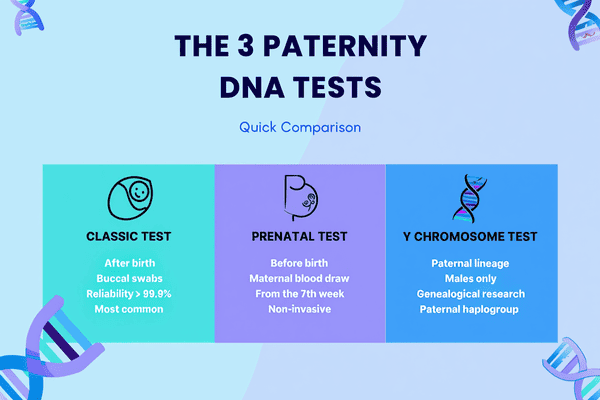
This paternity DNA test (the most common) is based on comparing the child’s DNA with that of the alleged father, using buccal swabs.
Paternity is confirmed with a probability greater than 99.9% and ruled out with 100% certainty.
Although not mandatory, the presence of the mother’s DNA can slightly improve the statistical accuracy of the result. This is particularly important in cases where the alleged fathers are full or half-brothers.
The prenatal DNA test to determine paternity before the child’s birth
This DNA test allows paternity to be determined during pregnancy, without waiting for the child’s birth. The non-invasive method (the most commonly used today) analyzes fetal DNA circulating in the mother’s blood starting from the 7th week of pregnancy. A simple blood draw from the mother is sufficient, with no risk to the fetus.
Invasive methods also exist, such as amniocentesis or chorionic villus sampling. However, these carry a risk of miscarriage and are performed only under strict medical supervision.
Y-Chromosome DNA Testing to Trace Your Paternal Lineage
The Y chromosome is one of the two sex chromosomes in men (XY). Passed from father to son with very few changes, it is an excellent marker for tracing the paternal lineage. Analyzing it allows for establishing a kinship link between two men from the same paternal lineage.
This test is exclusively for males and is useful for genealogical research or when the biological father has passed away. Offered by laboratories such as Quick DNA, FamilyTree DNA, Living DNA, EasyDNA, and TellmeGen, it also allows you to identify the paternal haplogroup and find genetic matches.
Paternity DNA Test: Legal Implications and Privacy Rights
In many countries, such as France, Australia, or the United Kingdom, the use of genetic material without consent is strictly regulated. These regulations aim to protect individuals’ rights and prevent any violation of privacy.
Laboratories have a legal obligation to secure their clients’ personal data.
In contrast, other countries take a more flexible approach by allowing at-home paternity DNA tests without the authorization of a judge or a healthcare professional.
Even in this case, data protection is an essential requirement.
Consent of the parties
No one can be forced to undergo a genetic test. Conducting a paternity DNA test without the consent of the individuals involved can lead to ethical and legal complications. For this reason, most laboratories require a consent form to be completed before performing the test. For a minor, the consent of a parent or legal guardian is required.
How does a paternity DNA test work?
Start by ordering a kit from the laboratory of your choice. It contains swabs to collect a buccal sample from each person. Once the samples have been collected, send them in individual labeled envelopes. The laboratory then analyzes the DNA profiles and sends the results within a few business days.
Rush paternity DNA testing
Several genetic laboratories offer an express service for analyzing DNA samples. With this service, results can be available in 2 to 3 days after shipment. Therefore, choose laboratories that offer the shortest turnaround times if you need your results urgently.
Paternity DNA testing in a legal context
To conduct this test in a legal context, you must:
- Justify your request
- Identify the individuals involved
- Provide a court order
Self-collection of samples at home is strictly inadmissible in a legal context. DNA samples must be collected at an accredited laboratory.
Alternatives when a smple from the presumed father Is unavailable
Sometimes, the presumed father has passed away, cannot be reached, or refuses to cooperate. In such cases, several solutions can compensate for the lack of direct DNA.
Using indirect DNA samples
The laboratory can analyze indirect samples: hair with roots, a toothbrush, a cigarette butt, fingernails, or a dried bloodstain. These allow for the creation of a genetic profile without the person’s direct involvement. However, the quality of the extracted DNA varies depending on the sample’s condition. Be sure to contact the laboratory in advance to verify whether the sample is usable.
Testing the alleged father’s siblings
Biological siblings share, on average, 50% of their genetic material. By testing one of the alleged father’s brothers or sisters, the laboratory can determine whether the child shares enough common genetic markers to establish a biological relationship.
This type of genetic analysis, often called a sibling DNA test, is less accurate than a parent-child test, but can still provide a degree of certainty.
Testing the alleged father’s relatives
Paternal uncles and aunts also share a significant portion of DNA with the alleged father. Their genetic profile can serve as an indirect reference to assess the probability of a biological relationship with the child.
The closer the kinship to the alleged father, the more reliable the result. The laboratory can calculate a probability of kinship based on this data, even if the conclusion is less definitive than with a direct test.
Analyzing the DNA of paternal grandparents
Paternal grandparents share 25% of their DNA with their grandchildren. By testing one or both grandparents, the laboratory compares their genetic markers to those of the child to identify a biological relationship. The results are more reliable when both grandparents participate, as their combined DNA profiles more closely resemble that of the absent father.
How long does it take to get the results of a paternity DNA test?
The turnaround time varies depending on the type of test and the laboratory chosen. For a standard at-home test, most laboratories deliver results within 3 to 5 business days after receiving the samples. Some offer an express option (24 to 48 hours) for an additional fee.
More complex tests (prenatal, Y-chromosome, analysis of discrete samples) take between 3 to 6 weeks. In the context of legal proceedings, the process may take longer due to mandatory steps, such as obtaining a court order.
Interpreting paternity test results
Results are provided in the form of a report detailing the genetic markers analyzed in both individuals tested. This report indicates a paternity index (expressed as a number, e.g., 1,000,000) as well as a probability of paternity expressed as a percentage. In some cases, the term “trio” is used to indicate that the mother, the alleged father, and the child have all been tested.
A positive result shows 99.9% to indicate near-certain paternity. Conversely, a negative result excludes paternity 100%, meaning that the man tested is not the biological father.
The result is definitive: it is either an inclusion or an exclusion, with no ambiguity or room for interpretation. You can always consult an expert or the laboratory if you have any doubts or questions.
Reliability and accuracy of results
The reliability of a paternity DNA test depends on the quality of the laboratory performing it. Analyses are conducted by laboratories accredited to international standards, such as ISO/IEC 17025.
These laboratories use advanced technologies such as PCR (polymerase chain reaction) and capillary electrophoresis to analyze the extracted DNA. DNA samples are double-checked to minimize errors. The higher the number of markers analyzed, the more accurate the result. Conversely, inexpensive kits sold by uncertified companies provide less reliable results.
Where can you get a paternity test?
Purchasing a home DNA kit from a laboratory certified to international standards is the most accessible option. In some countries (the United States, the United Kingdom, Belgium), some pharmacies offer kits for over-the-counter purchase.
How much do paternity tests cost?
The price varies depending on the type of test, the laboratory, and the number of people tested. A standard at-home test (father + child) costs between €70 and €200. More complex tests (non-invasive prenatal, Y-chromosome, analysis of a discrete sample) are more expensive, ranging from €150 to €400 depending on the technique used.
A non-invasive prenatal test ranges from €150 to €300 depending on the laboratory. In legal proceedings, the costs of biological testing are borne by the party requesting the test, unless the judge decides otherwise. These costs may vary depending on the court and the designated accredited laboratory.
Choosing the Best Paternity DNA Test: factors to consider
Before choosing a test, several criteria deserve your attention:
- Laboratory accreditation: choose a laboratory certified to ISO 17025 or accredited by the AABB
- The number of markers analyzed: the higher the number (ideally 20 or more), the more accurate the result will be
- The type of test: standard post-birth test, non-invasive prenatal test, Y-chromosome test… choose based on your specific situation.
- Legal validity: if you are planning legal proceedings, a home test will not suffice. Find out about the legal process.
- Turnaround time: Check the stated turnaround time and any express options available if urgency is required
- Data confidentiality: Ensure that the laboratory destroys your samples after analysis and does not retain your DNA profile.
- Quality of customer service: A reputable laboratory offers telephone support to answer your questions before and after the test.
- Value for money: compare offers by considering the number of markers analyzed, not just the listed price
Conclusion
Paternity tests are powerful tools that reveal biological ties and answer deeply personal questions. Science provides precise answers, but with legal and emotional implications. Before taking the plunge, educate yourself and weigh your decisions carefully.